April 2: Pamukkale to Kusadasi
Sarcophagus at Aphrodesias
Previous | April
2 Index | Next| Eclipse Home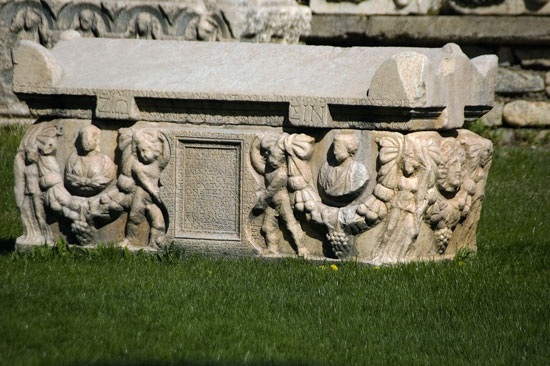
The ancient city of Aphrodisias, once the capital of the province of Lydia, is located near the village of Geyre in the district of Karacasu 38 km south of Nazilli. In ancient times, the attractive marble buildings of Aphrodisias no doubt shone out, as they do now, from amidst the rich vegetation of the Dandalaz valley with its almond, pomegranate and poplar trees.
The wealth, cultural and political importance of the city is clearly attested to by the size and magnificence of the buildings of which it is composed. The name Aphrodisias is derived from Aphrodite, the goddess of nature, beauty, love and plenty, and was one of the most famous cult centres of the goddess. But this was not the original name of the city. According to the historian Stephanus it was founded by the Lelegians and was first known as Lelegonopolis. The name of the city was later changed to Megalopolis, and later again to Ninoe after Ninos, the King of Assyria.
The history of the city can be traced back to the early bronze age and there is even clear evidence of a chalcolithic culture prior to the 3rd millennium B.C. The use of the name Aphrodisias began after the 3rd century B.C., in the Hellenistic period. The spread of Christianity under the Byzantine Empire and the gradual adoption of Christianity as the state religion resulted in a marked change in the status of the city. The cult centre of Aphrodite declined in importance, to such an extent that the names Aphrodite and Aphrodisias were finally erased from all the inscriptions. Efforts were made to change the name of the city to Stavrapolis, the City of the Cross, but the local inhabitants preferred to use Caria, the name of the province. Geyre, the name of the modern village occupying the same site, is probably a corruption of the ancient Caria, which occurred after the Turkish occupation of the area. It seems very likely that in Turkish, Caria was first pronounced Kayra, and that the "k" then changed to "g" and the "a" to "e'. Like several other Roman and Byzantine cities, Aphrodisias was very largely self sufficient.
Aphrodisias was one of the foremost cities of the age, surrounded by fertile fields producing every type of foodstuff. It also possessed a flourishing wool and cotton industry, highly developed commercial, political, religious and cultural institutions, very fine tradition of arts and crafts, world-famous schools of philosophy and sculpture and a large and energetic body of citizens.
The decline of the city was hastened by an unfortunate incident that took place in the 7th century. The reign of the Emperor Heraclius (610-641) was marked by Arab raids and incursions from the East, religious disputes, political and economic pressures and a number of epidemics causing great loss of life, but the final stroke was dealt by a devastating earthquake. The damage caused to the buildings by this earthquake is still plainly visible. Some of the most imposing buildings were destroyed and remained unrepaired.
Very little is known of the history of the city after the 7th century, sources of information being confined to a few religious documents and lists of the names of the bishops. Archaeological finds, however, would appear to point to a short lived revival in the 11th century.
The incursion of the Seljuk Turks from Anatolia between the 11th and 13th century meant the end of the settlements that had survived the great earthquakes. After the 13th century the whole province became subject to the Aydyn and Mentese Emirates. In the 15th and 16th centuries the fertile soil of the area attracted new settlement and the site of the ancient city of Aphrodisias was occupied by the village of Geyre.
The first thing you see on approaching Aphrodisias from the direction of Karacasu will be the city walls with the Ionic columns of the temple of Aphrodite in the background. The ancient city is locate on a level piece of ground inclining slightly towards the south-west.
The construction of the walls is thought to have been begun during the Gothic invasion in 260, but the walls to he seen today date from the 4th century or later. No trace has been found of any defense system of an older date, but there may well have been a wall around the acropolis in the area between the agora and the theatre. After the destruction of the walls by earthquake in the 7th century a fortress or observation tower was built here on the highest point in the city. This was one of the first two areas of settlement. Of the two excavation zones yielding prehistoric remains one is located on this hill, on which a fortress or observation tower was built in the 7th century, and the other of the site occupied by the temple of Aphrodite.
The remains found here indicate the existence of a settlement in prehistoric times with seven separate layers identified as belonging to the bronze and iron ages. Traces have been found here of mudbrick walls on stone foundations and architectural structures reminiscent of megaron type houses.
Here too were found fairly large jars known as pithoi used for the storage of wheat and other provisions as well as a considerable amount of pottery fragments. The finds also include a number of stone implements, stone statuettes, figures with the faces of owls and fat female idols as well as various weight-measuring instruments. The excavation area known as Pekmez Hoyuk to the east of the acropolis yielded pottery of the late neolithic, late chalcolithic and early bronze ages, together with two Kilia figurines. In the Late Hellenistic period the city developed more particularly in the area surrounding the agora. There is no question, however, of any genuine town planning. Neither the Temple of Aphrodite nor the Sebastion conforms to any regular city plan.